

| Investing & Wealth Strategy
“My advice to the trustee could not be more simple: Put 10% of the cash in short-term government bonds and 90% in a very low-cost S&P 500 index fund. I believe the trust’s long-term results from this policy will be superior to those attained by most investors — whether pension funds, institutions, or individuals — who employ high-fee managers.” — Warren Buffett, 2013 Berkshire Hathaway Shareholder Letter
Let that paragraph settle for a moment.
Warren Buffett — the man who has spent six decades hand-selecting individual stocks and allocating capital with a precision that no machine, algorithm, or army of analysts has ever matched — has instructed the trustee of his estate to put his widow’s inheritance into a plain, boring, low-cost S&P 500 index fund.
Not a hedge fund. Not a basket of carefully chosen stocks. Not a team of elite portfolio managers handpicked from the world’s best business schools. A Vanguard index fund. The same one available to anyone with a brokerage account and $1 to invest.
If this doesn’t stop you cold, read it again.
The world’s greatest stock picker — a man worth over $130 billion, with sixty years of experience beating the market — has decided that for the most important money in his life, the money that will sustain his family after he is gone, the right answer is the simplest one. And he has said so publicly, in writing, to millions of shareholders.
This is not a throwaway comment. It is a considered, deliberate instruction from the most credentialed investor in human history. And it contains more practical wisdom for ordinary investors than most financial advice you will ever receive.
The Letter That Shook an Industry
Every year, Warren Buffett writes a letter to Berkshire Hathaway shareholders. These letters are widely considered the greatest free investment education in existence. Business school professors assign them. Professional fund managers study them. Retail investors read them like scripture.
The 2013 letter, released in February 2014, contained the now-famous passage above — buried, almost casually, in a section about investment advice for non-professionals. Buffett was making a broader point about the wisdom of simplicity, and he chose to illustrate it with the most personal possible example: what he has arranged for his own family.
The instructions are specific. Not “invest conservatively.” Not “find a good advisor.” Not “diversify across asset classes.” The instructions are: 90% in a very low-cost S&P 500 index fund, 10% in short-term government bonds. Full stop.
The financial media covered it extensively. Investment professionals responded with a mixture of admiration and defensiveness. And millions of ordinary investors read it and asked the obvious question:
If this is good enough for Warren Buffett’s family, why isn’t it good enough for mine?
Why This Is So Counterintuitive
To appreciate the full weight of Buffett’s instruction, you have to understand what he is walking away from.
Buffett is not a passive investor. He is the opposite — one of the most active, intensive, hands-on investors who has ever lived. He reads financial statements for hours every day. He has spent decades building relationships with company management. He has an unmatched ability to estimate the intrinsic value of a business, to identify durable competitive advantages, and to wait patiently for the right price.
His track record is extraordinary. Berkshire Hathaway has compounded at roughly 20% per year since 1965 — against the S&P 500’s roughly 10%. Over that period, a dollar invested in Berkshire became approximately $40,000. A dollar in the S&P 500 became approximately $300.
Buffett has, demonstrably, beaten the index. By a lot. For a very long time.
And yet his advice — for his own family, with his own money — is not to try to replicate what he has done. It is to own the index.
Why?
Because he knows, better than anyone, that what he has done is not replicable by most people, most institutions, or most professional managers. His edge is a combination of temperament, experience, intellect, and opportunity that is effectively unrepeatable. He has watched generations of talented, hardworking professional investors try to do what he does and fail. He has studied the data. He knows that over long periods, the overwhelming majority of active managers underperform the very benchmark they are trying to beat.
For his widow — who will not be managing the portfolio herself, who will be relying on a trustee — the simplest, lowest-cost, most reliable strategy is the right one. Because it removes the human error, the fees, and the complexity that cause active management to fail.
The Hedge Fund Bet: A Decade-Long Proof
Buffett didn’t just write about his belief in index funds. He put $1 million on it.
In 2007, he made a public wager with Protégé Partners, a respected New York fund-of-funds manager. The bet: over ten years, a simple S&P 500 index fund would outperform a hand-selected basket of five hedge funds of funds — each of which represented dozens of individual hedge funds managed by some of the most sophisticated investors on earth.
The terms were straightforward. Both sides would invest $500,000 each in zero-coupon Treasury bonds (which would grow to approximately $1 million by the end date) and donate the proceeds to charity. Buffett chose the Vanguard S&P 500 Admiral Fund. Protégé chose five funds of funds they believed would outperform.
For the first few years, the bet looked competitive. The 2008 financial crisis hit the S&P 500 hard, and the hedge funds — designed to hedge against exactly this kind of downturn — held up better. By the end of 2008, the index fund was down 37%. The hedge funds were down an average of about 24%.
Protégé was looking good. The logic of active, downside-protected investing seemed vindicated.
And then the recovery happened.
The S&P 500 exploded upward from its March 2009 lows. The hedge funds — hamstrung by their own caution, their two-and-twenty fee structures, and their inability to simply hold on — struggled to keep pace. Year after year, the gap widened.
By the end of 2017 — the conclusion of the ten-year bet — the results were decisive:
- Buffett’s S&P 500 index fund: +125.8% cumulative return
- Protégé’s hedge fund basket: +36.3% cumulative return
The index fund won by nearly 90 percentage points over ten years. Not against amateur stock pickers — against professional hedge fund managers, charging premium fees, with access to the best research, technology, and talent money could buy.
Buffett donated his winnings to Girls Inc. of Omaha. And he used his 2017 shareholder letter to reflect on what the bet had proven — not just about hedge funds, but about the entire premise of paying for investment expertise.
The Psychology of “Deserving Better”
One of the most illuminating passages in Buffett’s shareholder letters is his explanation of why wealthy people resist the advice he gives freely. It is worth paraphrasing here because it explains something important not just about the rich, but about all of us.
The wealthy, Buffett observes, are accustomed to getting better versions of everything. Better food. Better education. Better healthcare. Better seats at the opera. In almost every domain of life, more money buys a meaningfully superior product.
So it feels natural — even rational — that more money should also buy better investment management. Surely a $10 million account managed by a team of Harvard-educated analysts should outperform a $10,000 account in a Vanguard index fund.
But investment returns don’t work like luxury goods. The market doesn’t give preferential treatment to large accounts or sophisticated strategies. The S&P 500 returns what it returns, and fees come off the top of everyone’s account equally — percentage-wise — regardless of wealth or prestige.
The emotional pull toward complexity and exclusivity in investing is one of the most expensive biases in personal finance. People pay for the feeling of sophistication. They pay for the narrative of being in something special, something not available to ordinary investors. And they pay, year after year, in the form of underperformance.
Buffett’s estate plan is his most public rebuke of this instinct. He is saying, as clearly as words allow: I know what the best investment management in the world looks like, because I have provided it. And for my own family, I am not choosing it. I am choosing the index.
What This Means for Your Portfolio
The lessons from Buffett’s estate plan are not complicated. They are:
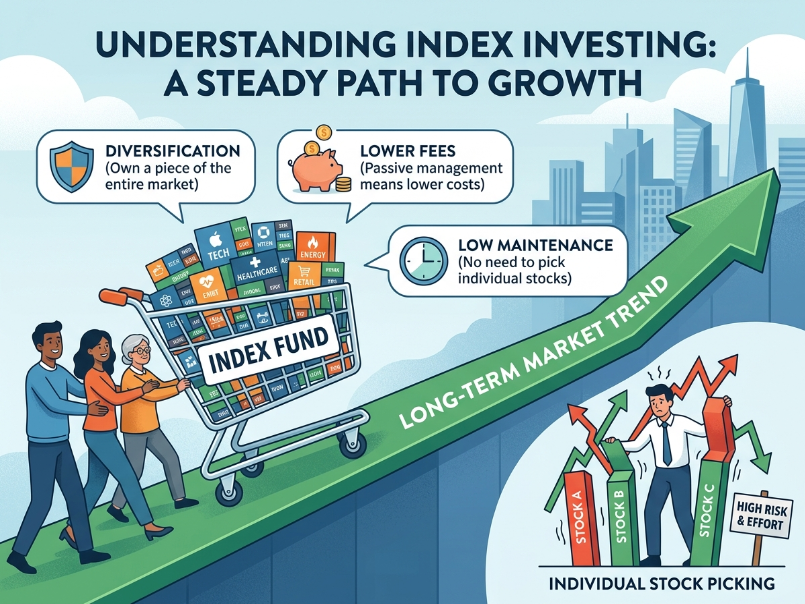
1. Costs are the most predictable drag on returns — and the most controllable. You cannot control what the market returns. You cannot control inflation, interest rates, or corporate earnings. But you can control what you pay. Every basis point of fees you eliminate is a guaranteed improvement in net returns. VTSAX charges 0.04% per year. The average actively managed fund charges over 1%. Over thirty years, that difference is worth hundreds of thousands of dollars on a modest portfolio.
2. Simplicity outperforms complexity when complexity brings costs. The hedge fund managers in Buffett’s bet were not stupid or lazy. They were talented, motivated professionals working with the best tools available. But their fee structures — typically 2% annually plus 20% of profits — created a headwind that even genuine skill could not overcome over time. Simple beats complex not because simple is better in theory, but because complex usually costs more in practice.
3. The strategy you can stick with beats the strategy that’s theoretically optimal. A 90/10 stock-bond split is not the academically perfect allocation for every investor. Depending on your age, risk tolerance, and goals, you might want more bonds, more international exposure, or different tilts. But the most important quality of any investment strategy is that you will actually follow it through a bear market. A simple index fund in a tax-advantaged account, automatically contributed to and never touched, will outperform a theoretically superior strategy that gets abandoned during the next crash.
4. You do not need to find the next Buffett. You need to own what Buffett owns. The S&P 500 index fund is available to you. Today. With no minimum investment through ETF equivalents like VOO or IVV. The same vehicle Buffett designated for his widow’s inheritance is accessible to anyone with a brokerage account and $1. The only question is whether you will use it — or spend your investing life searching for something better that the data says is unlikely to exist.
The Two-Fund Portfolio Inspired by Buffett’s Instructions
For investors who want to implement something close to Buffett’s exact recommendation, the translation is straightforward:
Core portfolio (working years, long time horizon):
- 90% — VOO or VTI (Vanguard S&P 500 or Total Market ETF)
- 10% — VGSH or BIL (short-term US government bonds or Treasury ETF)
Adjusted for age (within 10–15 years of retirement):
- Gradually shift bond allocation from 10% toward 20–40% depending on risk tolerance
- Keep equity portion in the same low-cost total market or S&P 500 fund
Tax location:
- Hold the bond fund in tax-advantaged accounts (401k, IRA) where interest income isn’t taxed annually
- Hold the equity ETF in taxable brokerage accounts where only realized gains are taxed
This is not sophisticated. It is deliberately, aggressively simple. That is the point.
One Final Thought
Warren Buffett has spent his career proving that it is possible to beat the market. He has done it more convincingly than almost any investor in history.
And he has also spent the last decade telling anyone who will listen that for almost everyone — including his own family — trying to beat the market is the wrong goal. The right goal is to capture the market’s returns, at the lowest possible cost, for the longest possible time.
That is not a counsel of mediocrity. The US stock market has turned $1 invested in 1965 into roughly $300 today. An investor who simply owned the index, paid minimal fees, and never sold would have participated in one of the greatest wealth-creation engines in human history.
You do not need to beat that. You need to own it.
Buffett has told you exactly how. The only question is whether you believe him.
Disclaimer: This article is for educational and informational purposes only. It is not personalized investment advice. Fund names, expense ratios, and contribution limits referenced are for illustrative purposes and may change over time. Always verify current figures and consult a qualified financial professional before making investment decisions.
Related reading:
- Why I Recommend VTSAX — And the Entire Case for Index Investing
- Why 90% of Professional Fund Managers Lose to the Index
- Write Your Investment Policy Statement Before the Next Crash




Leave a Reply