

Somewhere between your first paycheck and today, you probably figured out that nobody actually teaches
you how to manage money. Not in school, not at home for most people, and certainly not in the moment
when a credit card offer shows up in the mail. Recent surveys indicate that between 64% and 78% of
Americans were living paycheck to paycheck as recently as 2025, a figure that has remained stubbornly
high heading into 2026. That’s not a character flaw. It’s a knowledge gap, and it’s completely fixable.
Personal finance isn’t complicated once you see how the pieces fit together. It’s a practical skill set built
on five connected pillars: budgeting, saving, debt management, investing, and retirement planning. Master
one, and the others get easier. This guide walks through each pillar clearly, without jargon, so you can pick
a starting point and take a real step forward today.
What finance actually means (and why it directly affects your
life)
Finance is simply the management of money: how you earn it, allocate it, grow it, and protect it over time.
It’s not one thing, it spans three domains. Personal finance covers individuals and households. Corporate
finance covers businesses making decisions about capital and investment. Public finance covers
governments managing taxes, budgets, and public spending. For a concise external definition that lays
out these core functions, see this definition of finance from the Corporate Finance Institute.
For most people reading this, personal finance is the branch that matters most. It covers every money
decision you make from here forward, from how you pay your bills this month to whether you’ll have
enough to retire comfortably. The good news is that personal finance follows a logical sequence. When
you build a solid budget, saving becomes easier. When you save consistently, debt becomes less
overwhelming. When debt shrinks, investing becomes possible. It’s a system, not a checklist.
Budgeting and saving: the finance foundation everything else is
built on
A budget is just a decision made in advance about where your money goes. Without one, spending fills
whatever space is available, and saving becomes an afterthought. The 50/30/20 rule is one of the most
beginner-friendly frameworks available: 50% of your take-home pay goes to needs (rent, groceries,
utilities), 30% to wants (dining out, subscriptions, entertainment), and 20% to saving and debt payoff. The
exact percentages matter less than the discipline of following a system at all.
Building a monthly budget is straightforward: list all your income sources, list every fixed and variable
expense, then assign every remaining dollar a purpose. Review your spending at least once a month. A
budget is a living document that should shift as your income and circumstances change. Free tools and
apps can automate most of the tracking, so the work is lighter than it sounds.
Why your emergency fund comes before investing
Before you open a brokerage account, you need an emergency fund. The standard guideline, consistent
across most personal financial planning curricula, is three to six months of essential living expenses held
in a liquid, accessible account. Three months works well for people with stable income and low fixed
obligations; six months is the smarter target for anyone with variable income, dependents, or a less stable
job situation. Without this cushion, one unexpected car repair or medical bill can send you reaching for a
credit card, undoing months of progress in a single day. For a practical, step-by-step approach to building
that cushion, see this guide to building an emergency fund in 2026.
The best home for an emergency fund is a high-yield savings account (HYSA). These accounts are FDICinsured, meaning your money is protected up to $250,000, and they offer significantly higher interest rates
than a standard savings account. Keeping your emergency fund in a HYSA means your safety net is
working for you while it sits there, earning interest without adding any risk.
Debt management: getting ahead of it before it gets ahead of
you
Debt is the most emotionally charged topic in personal finance, which is exactly why most people avoid
dealing with it head-on. The average American carrying credit card debt holds a balance of around $7,886
at an interest rate in the low-to-mid 20% APR range. At those rates, minimum payments barely touch the
principal. The way out is a clear, consistent strategy. For current statistics and wider context on consumer
credit card balances and trends, review LendingTree’s summary of credit card debt statistics.
Not all debt deserves the same urgency. High-interest consumer debt, primarily credit cards, functions like
a financial emergency because the cost of carrying it grows faster than most investments can offset.
Low-interest debt, such as a federal student loan or a fixed-rate mortgage, can be managed more
gradually while you build other areas of your financial life. The goal isn’t to be completely debt-free before
you do anything else; it’s to have a plan.
The debt snowball vs. the debt avalanche
The two most effective payoff strategies are the snowball and the avalanche. The snowball method
targets your smallest balance first, regardless of interest rate. You pay it off, feel the win, and roll that
payment into the next smallest debt. The psychological momentum is real, and for people who need early
motivation to stay consistent, it works well. The avalanche method targets your highest-interest debt first,
saving the most money over time. It’s the mathematically optimal choice, though it requires patience
when the highest-rate balance also happens to be the largest one.
That calculus changes once you factor in your employer’s retirement plan. For many people, the more
pressing question isn’t snowball vs. avalanche, it’s whether to pay off debt or start investing at all. The
clearest framework: always contribute enough to your employer-sponsored retirement plan to capture the
full employer match first. That match is an immediate 50, 100% return on your contribution, and skipping
it is leaving free money on the table. After capturing the match, focus aggressively on any debt above
roughly 7, 8% interest. Once that’s cleared, redirect that cash flow into both continued debt payoff and
investing simultaneously.
Investing basics: how everyday people build real wealth
Investing is how money grows faster than inflation over time. It’s not reserved for people with large
portfolios or advanced knowledge of financial markets. The core principle is straightforward: put money
into assets that increase in value or generate income over a long-term horizon. The relationship between
risk and return is fundamental here. Higher potential gains require accepting more short-term uncertainty,
and that uncertainty is manageable, not dangerous, when you have two things working in your favor:
diversification and time.
Index funds and ETFs: the beginner investor’s best starting point in
personal finance
Index funds and ETFs (exchange-traded funds) let you own small pieces of hundreds or thousands of
companies through a single purchase. Instead of betting on one stock, you’re spreading exposure across
an entire market or sector. The key cost metric to watch is the expense ratio, the annual fee charged as a
percentage of your investment. Low-cost index funds with expense ratios below 0.10% consistently
outperform the majority of actively managed funds over long periods, largely because lower fees mean
more of your money stays invested and compounds.
Dollar-cost averaging (DCA) is the strategy that removes the pressure of picking the right moment to
invest. You invest a fixed amount on a regular schedule, regardless of whether the market is up or down.
When prices are high, your fixed amount buys fewer shares. When prices are low, it buys more. Over time,
this approach smooths out market volatility and builds the habit of consistent investing that produces real
results through compounding over decades.
Retirement planning: why starting now always beats starting
perfectly
Retirement planning is not something to defer until you feel more financially stable. Compound interest
rewards time above almost everything else. A 25-year-old who invests even modest amounts in a taxadvantaged retirement account for 40 years will likely outperform a 35-year-old who starts with larger
contributions but has 10 fewer years of compounding. The earlier you start, the less you need to
contribute to reach the same outcome.
401(k) accounts and the employer match you should never skip
A 401(k) is a workplace retirement account where your contributions reduce your taxable income today,
and your investments grow tax-deferred until withdrawal. For 2026, the employee contribution limit is
$24,500. Two catch-up provisions apply if you’re older: workers aged 50 and above can contribute up to
$32,500, while those between 60 and 63 qualify for a super catch-up provision that raises the ceiling to
$35,750. Regardless of which tier applies to you, the most important first step is contributing at least
enough to capture your employer’s full match, an immediate return no other investment can guarantee.
See the IRS announcement of the 2026 401(k) contribution limits for the official guidance.
Roth IRA vs. traditional IRA: which one fits where you are now
A traditional IRA gives you a tax deduction today, with taxes paid when you withdraw in retirement. A Roth
IRA is funded with after-tax dollars, but your money grows and withdraws completely tax-free. For most
younger earners who expect to be in a higher tax bracket later in life, the Roth IRA is the stronger choice,
you’re paying taxes now at a lower rate in exchange for tax-free income later. For 2026, the contribution
limit for both account types is $7,500 per year, or $8,600 if you’re 50 or older. Roth IRA eligibility phases
out for single filers earning between $153,000 and $168,000 MAGI, and for married filers between
$242,000 and $252,000.
Your next step in personal finance starts with one pillar
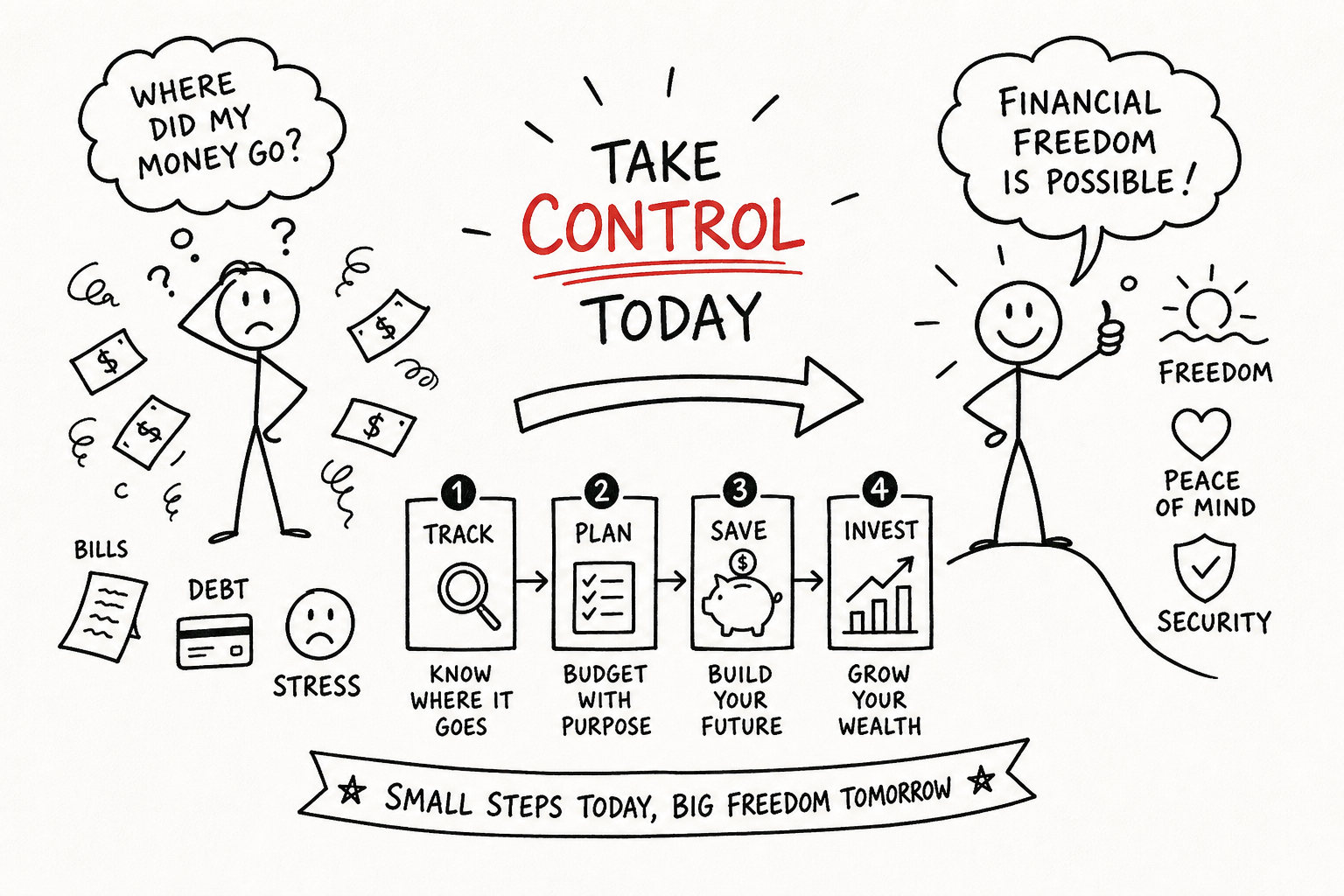
These five pillars work together as a single system. Budgeting gives you control over your cash flow,
saving builds the safety net that protects everything else, and debt management frees up income you can
redirect toward your future. Once those foundations are in place, investing and retirement planning grow
your wealth over time so your future self isn’t starting from zero. Progress in one area creates real
momentum across all of them, you don’t need to master everything at once.
Pick the pillar that feels most relevant to where you are right now. If you’re not sure where to start,
FinanceQuiver.com has step-by-step guides on each of these topics, from choosing your first ETF and
comparing retirement accounts to debt payoff strategies and high-yield savings comparisons. The
resources are free, practical, and written for people who are learning, not people who already know
everything. If you’re one of the many Americans living paycheck-to-paycheck, there are targeted, small
steps you can take today to build breathing room, see this overview of how many Americans live
paycheck-to-paycheck for context and next steps. Start with one step today, and let the system do the
rest.
How to Take Control of Your Finances StartingToday











Leave a Reply