

Investing & Personal Finance
“Don’t look for the needle in the haystack. Just buy the haystack.” — John Bogle, founder of Vanguard
Dear younger me — or whoever needs to hear this —
I’m going to explain something to you that took most people decades to figure out, that the investment industry spends billions of dollars per year trying to obscure, and that, once understood, makes the rest of personal finance feel almost embarrassingly simple.
It won’t take long. The truth rarely does.
By the end of this letter, you will know exactly what to invest in, why, and what to do tomorrow morning. There will be no ambiguity. No “it depends.” No list of twelve factors to weigh before deciding. Just a clear, honest answer — the one I wish someone had given me at 22.
Let’s begin.
What Most People Think Investing Is
Most people — especially those new to it — imagine investing as a process of selection. You study companies. You identify the good ones. You buy their stock. You profit.
This is what the financial media portrays. It’s what stock-picking shows celebrate. It’s what most brokerage platforms are designed to encourage. The interface looks like a casino floor: tickers scrolling, charts moving, buy and sell buttons prominently placed.
The implicit message is that investing is an active game. That knowledge, effort, and intelligence translate into better returns. That somewhere out there is the next Apple or Amazon, and if you’re smart enough and fast enough, you’ll find it before everyone else does.
This model is seductive. It is also almost entirely wrong.
What Investing Actually Is
Investing, at its core, is the act of lending your money to businesses and collecting a share of their future earnings.
When you buy a share of stock, you own a tiny fraction of a real company — its factories, its software, its brand, its employees’ collective output. That company earns money. Some of that money is reinvested to grow the business. Some is returned to you as dividends. Over time, as the economy grows and the company grows, the value of your ownership stake grows with it.
The US stock market — all the companies listed on American exchanges — has returned an average of roughly 10% per year nominally (about 7% after inflation) over the past century. Through depressions, wars, recessions, panics, and political upheaval, the long-run direction has been up, because the long-run direction of human economic output has been up.
The question for an investor is simple: how do I participate in that long-run growth as efficiently as possible, with as little cost and as little risk of catastrophic error as possible?
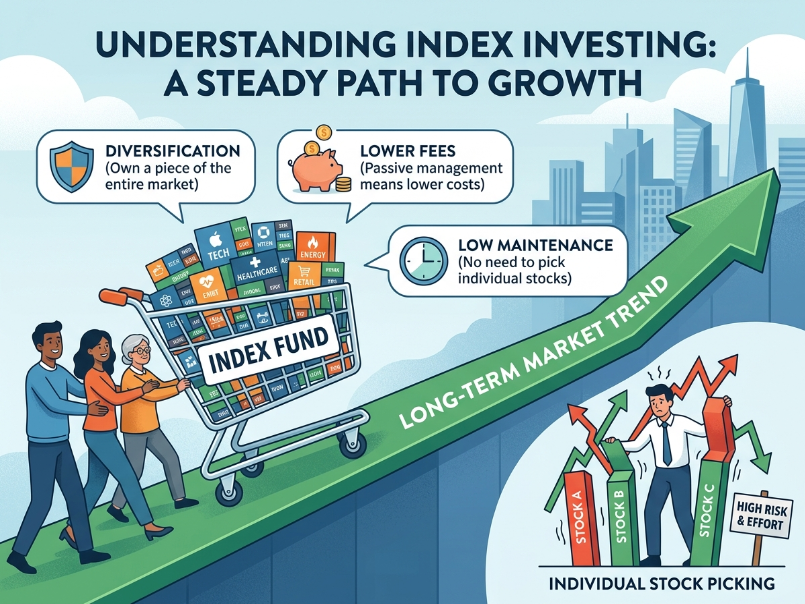
The answer is index funds. Specifically, for most Americans, a total US market index fund. The most popular example is VTSAX — Vanguard’s Total Stock Market Index Fund Admiral Shares.
What VTSAX Actually Is
VTSAX is not a stock. It is a fund — a single investment vehicle that owns shares in approximately 3,700 companies listed on US stock exchanges. Large ones, small ones, growing ones, boring ones. Every sector. Every industry. Every size.
When you buy one share of VTSAX, you own a tiny fraction of every publicly traded company in America simultaneously. Apple. ExxonMobil. Your local regional bank. The startup that went public last quarter. The railroad company that’s been around since 1850.
All of them. At once.
The fund is “passive” — meaning it doesn’t try to pick winners or avoid losers. It simply owns everything, in proportion to each company’s market value. When a company grows, its weighting in the fund grows. When a company shrinks or fails, it shrinks in the fund and eventually disappears. The market itself does the sorting.
Its expense ratio — the annual fee you pay to own it — is 0.04% per year. That is four cents per year on every $100 invested.
That number matters enormously. Let’s talk about why.
The Fee Drag: A 30-Year Calculation That Will Change How You Think
Imagine two investors. Both invest $10,000 at age 25. Both earn 8% average annual returns before fees over 30 years. The only difference is what they pay.
Investor A owns VTSAX — expense ratio: 0.04%. Investor B owns an actively managed mutual fund — expense ratio: 1.0% (below the industry average, actually).
After 30 years:
- Investor A has approximately $99,400
- Investor B has approximately $76,100
Investor B paid what sounded like a small, reasonable fee — 1% — and ended up with $23,300 less. That is 23% of their final portfolio, gone. Not to the market. Not to taxes. To fees.
Now extend this to a full career of investing — say, $500/month invested over 35 years:
- Investor A (0.04% fee): ~$1,143,000
- Investor B (1.0% fee): ~$892,000
The difference is $251,000. A quarter of a million dollars, consumed by a fee that sounded like “just 1%.”
And this is a conservative comparison. Many actively managed funds charge 1.5–2% annually. Hedge funds charge “2 and 20” — 2% annual fee plus 20% of profits. Financial advisors who charge a percentage of assets under management typically add another 0.5–1% on top of fund fees.
Every fraction of a percent matters, because every fraction of a percent compounds against you, silently, every single year, for decades.
Why Stock Pickers Almost Always Lose to the Index
Here is the foundational mathematical truth that the investment industry cannot escape:
In any given market, all investors collectively own the entire market. The average investor, before costs, earns the average market return. After costs, the average investor earns the market return minus their fees.
This means that for every active investor who beats the market, there must be another active investor who underperforms by the same amount — to keep the average intact. In every trade, there is a buyer and a seller. One of them is wrong.
Now add fees. Every actively managed fund charges more than an index fund. This means that after fees, the average active investor must underperform the index. Not because they’re bad at their jobs. Because mathematics requires it.
This isn’t theory. The data confirms it with remarkable consistency.
The SPIVA Scorecard — published by S&P Dow Jones Indices twice annually — tracks how actively managed funds perform against their relevant index benchmarks. The findings, updated year after year for decades, are striking:
- Over 1 year: roughly 60–65% of US large-cap active funds underperform the S&P 500
- Over 5 years: roughly 75–80% underperform
- Over 15 years: roughly 88–92% underperform
The longer the time horizon, the worse active management looks. This is not because fund managers are getting worse. It is because fees compound, transaction costs accumulate, and the randomness of short-term outperformance cannot be sustained indefinitely against the relentless mathematical headwind of higher costs.
“But What About the Managers Who Do Beat the Market?”
This is the best objection, and it deserves a direct answer.
Yes, some active managers beat the market — even over long periods. They exist. The question is: can you identify them in advance?
The answer, again from the data, is effectively no.
Morningstar and S&P Dow Jones both track whether funds that outperform in one period continue to outperform in the next. The finding is consistent: past outperformance has almost no predictive power for future outperformance. The funds in the top quartile of returns in one five-year period are nearly randomly distributed across quartiles in the next five-year period.
This means that even if you identified last decade’s great active fund managers — and paid their higher fees to access them — you would have essentially no better odds of outperformance than picking randomly. You’d just pay more for the privilege of trying.
There is one exception: Warren Buffett. He has beaten the market over decades by a meaningful margin. But Buffett himself has explicitly and repeatedly told ordinary investors not to try to do what he does, and to put their money in a low-cost S&P 500 index fund instead. The man who built one of the greatest investment records in history recommends the index. That is not a small endorsement.
Simplicity Is a Feature, Not a Limitation
One of the strangest objections to index fund investing is that it’s too simple. That doing nothing — buying the whole market and holding — can’t possibly be the right answer when there are so many smart people working so hard to find better ones.
But simplicity in investing is not a compromise. It is an active strategy with specific, demonstrable advantages.
It removes emotion from the equation. When you own “everything,” there is no individual stock to panic about, no earnings report to obsess over, no CEO scandal that wrecks your portfolio. You own the market, and the market, over time, goes up.
It eliminates the risk of catastrophic single-stock failure. Enron employees who held company stock in their 401(k) lost everything. Lehman Brothers employees lost most of it. Index fund investors lost nothing in either case — those companies were small parts of a large whole, and when they failed, the index moved on without them.
It scales perfectly. Whether you’re investing $50 a month or $50,000 a month, the strategy is identical. There is no point at which you “outgrow” it and need something more sophisticated.
It frees your mental energy. Every hour spent researching individual stocks, reading analyst reports, and second-guessing allocations is an hour not spent on your career, your relationships, or the things that actually make life good. The index investor redirects all of that energy elsewhere and, statistically, still comes out ahead.
The One Portfolio a Beginner Should Own
Here it is, without hedging:
For a US-based investor under 40 with a long time horizon:
Invest everything in VTSAX (Vanguard Total Stock Market Index Fund Admiral Shares) or its ETF equivalent VTI (same fund, same holdings, tradeable on any brokerage).
If you want international diversification — which is reasonable — add VXUS (Vanguard Total International Stock ETF) at 20–30% of your portfolio.
If you’re within 10–15 years of retirement and want to reduce volatility, add BND (Vanguard Total Bond Market ETF) at whatever percentage helps you sleep at night.
That’s it. Three funds. The famous “three-fund portfolio.” It has been written about, studied, modeled, and endorsed by some of the most rigorous financial thinkers alive. It requires roughly 30 minutes per year to rebalance. It will, based on all historical evidence, outperform the vast majority of actively managed alternatives over any 20+ year period.
What to Do Tomorrow Morning
This is the part most personal finance articles skip — the specific, frictionless next step. Here it is:
Step 1: Open a Vanguard account (vanguard.com) or a brokerage that offers Vanguard ETFs with no transaction fees (Fidelity and Schwab both do). This takes about 15 minutes.
Step 2: If you have a 401(k) at work, log in today and find the lowest-cost index fund available — typically something labeled “Total Market Index,” “S&P 500 Index,” or “Large Cap Index.” Set your contribution to at least the employer match. If there’s no employer match, target 15% of your gross income.
Step 3: Open a Roth IRA if you haven’t already. Contribute up to the annual limit ($7,000 in 2024, $7,500 if you’re over 50). Invest it in VTSAX or VTI.
Step 4: Set up automatic contributions. Every paycheck, automatically. So you never have to decide, never have to remember, and never have to overcome inertia.
Step 5: Stop checking. Seriously. Set it, automate it, and check it once a year. The financial news cycle will give you approximately 400 reasons per year to deviate from your plan. None of them will be worth acting on.
The Letter’s Real Point
This letter isn’t really about VTSAX. VTSAX is a vehicle. The real point is simpler and older:
The market rewards ownership and patience. It punishes trading, fees, and fear. It is indifferent to cleverness and expertise. And the most effective investment strategy available to ordinary people is also the most boring one: own everything, pay almost nothing, and wait.
You don’t need a financial advisor to execute this strategy. You don’t need a CFA, a Bloomberg terminal, or a subscription to any investment newsletter. You need a brokerage account, a paycheck, and the willingness to do almost nothing for a very long time.
The investment industry has spent decades convincing you that this can’t be right. That complexity is necessary. That professional management is worth paying for. That you need help navigating something so consequential.
You don’t. The haystack is available. You can buy it this afternoon.
John Bogle spent his life making that possible. The least you can do is take him up on it.
Disclaimer: This article is for educational purposes only and reflects general financial principles. VTSAX, VTI, VXUS, and BND are mentioned for illustrative purposes; this is not a personalized investment recommendation. Tax rules, contribution limits, and fund availability change over time — verify current figures before acting. Consult a qualified financial professional before making major financial decisions.
Related reading:
- What Warren Buffett’s Estate Plan Teaches Ordinary Investors
- The 5 Hurdles Stopping You from Getting Rich Slowly
- Why 90% of Professional Fund Managers Lose to the Index



Leave a Reply