


Investing & Stock Market |
Here’s a truth most people learn too late: keeping money in a savings account is losing money. With inflation running at 5–6% a year, and savings accounts offering 3–4%, your $1 lakh today will have the purchasing power of roughly $ 94,000 next year — without you spending a rupee.
Investing is how you fight back. And the good news is, you don’t need to be rich to start.
Why Investing Matters More Than Saving
Let’s look at a simple example.
Suppose you save ₹5,000 every month:
| Strategy | After 20 Years |
|---|---|
| Under the mattress | $12,00,000 |
| Savings account (4%) | $18,30,000 |
| Mutual funds (12% avg.) | $ 49,90,000 |
Same amount saved. Completely different outcomes. The difference? Compound interest — earning returns not just on what you invest, but on your previous returns too. Albert Einstein reportedly called it the eighth wonder of the world, and the math backs him up.
The Investment Ladder: Where Beginners Should Start
Think of investing like climbing a ladder — start at the bottom and work your way up as your knowledge and comfort grow.
Rung 1 — Emergency Fund First
Before you invest a single rupee, make sure you have 3–6 months of living expenses saved in a liquid account (like a savings account or liquid mutual fund). This is your safety net. Without it, any market dip could force you to sell investments at a loss.
Rung 2 — Mutual Funds via SIP
Systematic Investment Plans (SIPs) are the most beginner-friendly way to invest. You set up an automatic monthly investment — even $500 — into a mutual fund, and it runs on autopilot.
Why mutual funds?
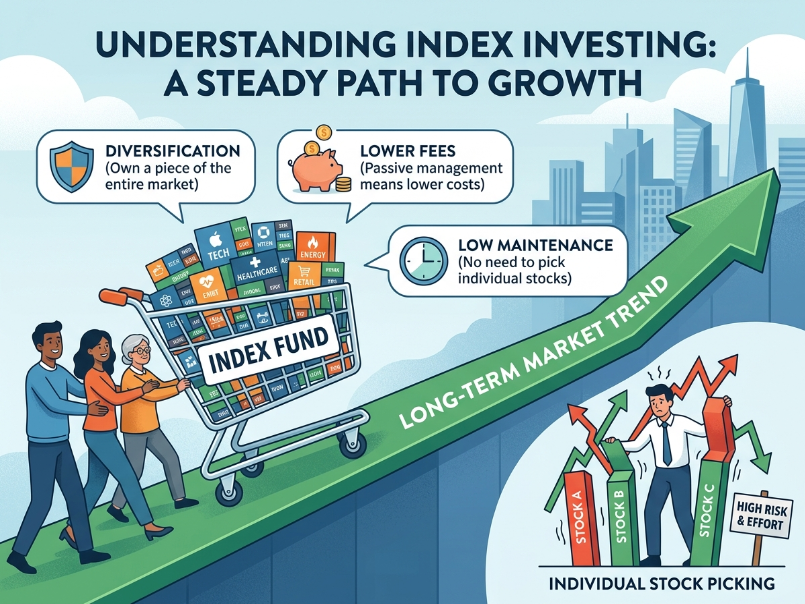
- Diversification — your money is spread across dozens or hundreds of companies
- Professional management — fund managers do the research for you
- Low entry barrier — start with as little as $100/month
- Flexibility — you can stop, pause, or withdraw anytime
For beginners, index funds are the best starting point. These simply track a market index (like the NASDAQ) and have low fees. Over long periods, they consistently outperform most actively managed funds.
Rung 3 — Direct Stocks
Once you understand markets better, you can start buying shares of individual companies. This offers higher potential returns but requires more research and comes with higher risk.
Rule of thumb: never put money into stocks you can’t afford to lose, and always invest for the long term (5+ years).
Rung 4 — Alternative Investments
Real estate, gold ETFs, REITs, bonds — these are diversifiers for when you’ve built a solid foundation. Don’t start here.
The Three Principles Every Beginner Must Know
1. Start Early, Not Big
Time in the market beats timing the market. Someone who invests $3,000/month from age 25 will likely end up with more than someone who invests $6,000/month starting at age 35 — even though the late starter put in more total money. That’s compounding at work.
2. Don’t Panic During Market Dips
Markets go up and down — that’s normal. The worst thing a beginner can do is sell when markets fall. In fact, market dips are opportunities to buy more at lower prices. Your SIP automatically does this for you (called “rupee cost averaging”).
3. Keep Costs Low
Investment returns are uncertain. Fees are guaranteed. A fund charging 2% annually will eat into your returns significantly over 20 years compared to an index fund charging 0.1–0.5%. Always check the Expense Ratio before investing.
How to Actually Get Started
- Complete your KYC — link Aadhaar and PAN on any SEBI-registered platform
- Choose a platform — Zerodha, Groww, Kuvera, or Paytm Money are popular, beginner-friendly options
- Start a SIP — pick a Nifty 50 index fund and set up a monthly SIP
- Set it and forget it — check in quarterly, not daily
- Increase your SIP every time your salary increases
Common Beginner Mistakes to Avoid
- Chasing “hot” stocks or tips from friends, social media, or news channels
- Investing money you might need soon — investments work best with a 5+ year horizon
- Stopping SIPs when markets fall — that’s exactly when you should continue
- Not diversifying — don’t put everything in one stock or sector
The Bottom Line
You don’t need to understand every financial term or predict the market. You just need to start, stay consistent, and stay patient. The stock market has historically delivered 10–12% annual returns over long periods — but only to those who stick around long enough to collect.
Your best investment is the one you actually make today.
Next up: What is cryptocurrency, and should beginners consider it? Read our beginner’s guide to crypto.Investing 101: How to Make Your Money Work for You (Even If You’re Starting From Zero)
Investing & Stock Market | 7 min read
Here’s a truth most people learn too late: keeping money in a savings account is losing money. With inflation running at 5–6% a year, and savings accounts offering 3–4%, your ₹1 lakh today will have the purchasing power of roughly ₹94,000 next year — without you spending a rupee.
Investing is how you fight back. And the good news is, you don’t need to be rich to start.
Why Investing Matters More Than Saving
Let’s look at a simple example.
Suppose you save ₹5,000 every month:
| Strategy | After 20 Years |
|---|---|
| Under the mattress | ₹12,00,000 |
| Savings account (4%) | ₹18,30,000 |
| Mutual funds (12% avg.) | ₹49,90,000 |
Same amount saved. Completely different outcomes. The difference? Compound interest — earning returns not just on what you invest, but on your previous returns too. Albert Einstein reportedly called it the eighth wonder of the world, and the math backs him up.
The Investment Ladder: Where Beginners Should Start
Think of investing like climbing a ladder — start at the bottom and work your way up as your knowledge and comfort grow.
Rung 1 — Emergency Fund First
Before you invest a single rupee, make sure you have 3–6 months of living expenses saved in a liquid account (like a savings account or liquid mutual fund). This is your safety net. Without it, any market dip could force you to sell investments at a loss.
Rung 2 — Mutual Funds via SIP
Systematic Investment Plans (SIPs) are the most beginner-friendly way to invest. You set up an automatic monthly investment — even ₹500 — into a mutual fund, and it runs on autopilot.
Why mutual funds?
- Diversification — your money is spread across dozens or hundreds of companies
- Professional management — fund managers do the research for you
- Low entry barrier — start with as little as ₹100/month
- Flexibility — you can stop, pause, or withdraw anytime
For beginners, index funds are the best starting point. These simply track a market index (like the Nifty 50) and have low fees. Over long periods, they consistently outperform most actively managed funds.
Rung 3 — Direct Stocks
Once you understand markets better, you can start buying shares of individual companies. This offers higher potential returns but requires more research and comes with higher risk.
Rule of thumb: never put money into stocks you can’t afford to lose, and always invest for the long term (5+ years).
Rung 4 — Alternative Investments
Real estate, gold ETFs, REITs, bonds — these are diversifiers for when you’ve built a solid foundation. Don’t start here.
The Three Principles Every Beginner Must Know
1. Start Early, Not Big
Time in the market beats timing the market. Someone who invests ₹3,000/month from age 25 will likely end up with more than someone who invests ₹6,000/month starting at age 35 — even though the late starter put in more total money. That’s compounding at work.
2. Don’t Panic During Market Dips
Markets go up and down — that’s normal. The worst thing a beginner can do is sell when markets fall. In fact, market dips are opportunities to buy more at lower prices. Your SIP automatically does this for you (called “rupee cost averaging”).
3. Keep Costs Low
Investment returns are uncertain. Fees are guaranteed. A fund charging 2% annually will eat into your returns significantly over 20 years compared to an index fund charging 0.1–0.5%. Always check the Expense Ratio before investing.
How to Actually Get Started
- Complete your KYC — link Aadhaar and PAN on any SEBI-registered platform
- Choose a platform — Zerodha, Groww, Kuvera, or Paytm Money are popular, beginner-friendly options
- Start a SIP — pick a Nifty 50 index fund and set up a monthly SIP
- Set it and forget it — check in quarterly, not daily
- Increase your SIP every time your salary increases
Common Beginner Mistakes to Avoid
- Chasing “hot” stocks or tips from friends, social media, or news channels
- Investing money you might need soon — investments work best with a 5+ year horizon
- Stopping SIPs when markets fall — that’s exactly when you should continue
- Not diversifying — don’t put everything in one stock or sector
The Bottom Line
You don’t need to understand every financial term or predict the market. You just need to start, stay consistent, and stay patient. The stock market has historically delivered 10–12% annual returns over long periods — but only to those who stick around long enough to collect.
Your best investment is the one you actually make today.
Next up: What is cryptocurrency, and should beginners consider it? Read our beginner’s guide to crypto.










Leave a Reply