

Why Most Young People Never Manage to Save Anything ?
The paycheck arrives. Two weeks later, it’s gone — and you’re not entirely sure where it went. You tell yourself next month will be different. It never is. Sound familiar?
You are not alone. According to a 2024 Bankrate survey, nearly 57% of Americans cannot cover a $1,000 emergency from savings. Among adults under 35, that number climbs even higher. Globally, the story is similar — a 2023 OECD report found that young adults in most developed nations save less than 5% of their income on average.
But here is what the statistics miss: this is almost never a discipline problem. It is a system problem. When there is no clear structure for where money goes, it flows toward whatever feels urgent or pleasurable in the moment — and the future always loses that battle.
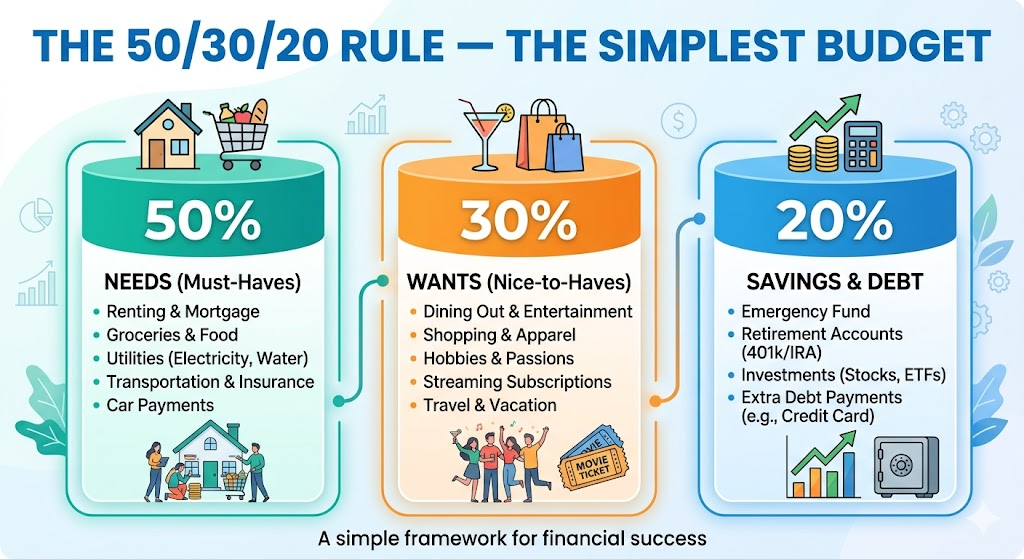
The 50/30/20 rule is the simplest, most proven budget framework in personal finance. It requires no complex spreadsheet, no financial background, and no dramatic lifestyle sacrifice. It is a single idea applied consistently, and it has helped millions of people take control of their money for the first time.
What Is the 50/30/20 Rule? A Clear Breakdown
Popularized by U.S. Senator Elizabeth Warren and her daughter Amelia Warren Tyagi in their book “All Your Worth” (2005), the 50/30/20 rule divides your after-tax (take-home) income into three intentional categories.
50% — Needs (Essential Living Expenses)
Half of your after-tax income covers everything you genuinely cannot live without:
- Rent or mortgage payments
- Groceries and basic food
- Utilities — electricity, gas, water, internet
- Health insurance premiums and essential medications
- Transportation — car payment, gas, public transit passes
- Minimum debt payments (student loans, credit cards)
- Phone bill
If your needs consistently exceed 50%, it is a signal that your largest fixed costs — usually housing or transportation — are oversized relative to your income. In expensive cities like New York, San Francisco, or London, many people find this 50% threshold genuinely difficult. The solution is not to abandon the rule but to examine whether a roommate, a cheaper neighborhood, or a longer commute might unlock financial headroom.
30% — Wants (Lifestyle & Discretionary Spending)
This category is your guilt-free spending zone — but it must stay within 30%:
- Dining out and coffee shops
- Streaming services (Netflix, Spotify, Hulu, Disney+)
- Gym memberships and fitness classes
- Travel and vacations
- Shopping for clothing beyond basics
- Hobbies and entertainment
- Concerts, sporting events, nights out
The 30% category is not a reward you earn after saving — it is a deliberate allocation. Living with zero discretionary spending is unsustainable and leads to burnout and binge spending. The goal is intentional enjoyment within defined limits.
20% — Savings & Investments (Your Future Self)
This is the wealth-building engine — and the category most people skip entirely:
- Emergency fund contributions
- 401(k) or employer retirement plan contributions (especially to capture the full employer match)
- Roth IRA or Traditional IRA contributions
- Brokerage account investments (index funds, ETFs)
- High-yield savings account for short-term goals
- Extra debt payments beyond minimums (especially high-interest credit card debt)
The philosophical foundation of this rule: pay your future self before you pay for your lifestyle. Savings should not be what is left over after spending. Savings should be the first transfer made when the paycheck arrives — before any other spending decision.
Applying the 50/30/20 Rule to Real Salaries — Detailed Examples
Example 1: $45,000 Annual Gross / ~$36,000 After Tax (Entry-Level, Mid-Size City)
Take-home income: ~$3,000/month
| Category | Percentage | Monthly Amount |
|---|---|---|
| Needs (rent, groceries, utilities, transport) | 50% | $1,500 |
| Wants (dining, streaming, entertainment) | 30% | $900 |
| Savings & Investments | 20% | $600 |
At $600/month invested in a low-cost index fund averaging 10% annual returns, you would accumulate approximately $46,000 in 5 years, $122,000 in 10 years, and $456,000 in 20 years. From a $45,000 salary. No inheritance. No lottery. Just a budget and time.
Example 2: $75,000 Annual Gross / ~$57,000 After Tax (Mid-Level Professional)
Take-home income: ~$4,750/month
| Category | Percentage | Monthly Amount |
|---|---|---|
| Needs | 50% | $2,375 |
| Wants | 30% | $1,425 |
| Savings & Investments | 20% | $950 |
$950/month invested for 25 years at 10% average returns = approximately $1.25 million. One rule. Applied consistently. Life-changing result.
Example 3: £35,000 Annual Gross / ~£27,500 After Tax (UK Context)
Take-home: ~£2,292/month
| Category | Percentage | Monthly Amount |
|---|---|---|
| Needs | 50% | £1,146 |
| Wants | 30% | £687 |
| Savings & Investments | 20% | £458 |
£458/month invested for 20 years at 8% average returns (more conservative estimate) = approximately £272,000. This is achievable on a standard UK graduate salary.
The Four Steps to Actually Implement This Budget Starting Today
Step 1: Know Your Exact After-Tax Monthly Income Do not use your gross salary. Use what actually hits your bank account every month after federal taxes, state taxes, Social Security, Medicare, and any pre-tax deductions (401k contributions, health insurance). This is your real operating budget.
Step 2: List and Categorize Every Monthly Expense Write down every regular monthly expense and categorize it honestly as a “Need” or “Want.” This exercise alone creates powerful financial awareness — most people underestimate their actual spending by 15–25%.
Step 3: Automate the 20% on Payday The moment your paycheck hits your account, a portion of it should automatically transfer to your savings or investment account — before you can spend it. Most banks allow you to set up automatic transfers on a schedule. Use this. The best financial habit in the world is making good financial decisions automatic rather than relying on willpower.
Step 4: Review Monthly, Adjust Quarterly Check your category spending at the end of each month. Are you consistently over in “Wants”? Are “Needs” creeping above 50%? Small adjustments made consistently compound into dramatically better financial outcomes over time.
The Biggest 50/30/20 Mistakes (And How to Avoid Them)
Mistake 1: Using Gross Income Instead of Net Income Calculating 20% of your $75,000 salary and expecting to save $15,000/year — but your after-tax income is actually $57,000 — leads to a plan built on incorrect math. Always start from take-home pay.
Mistake 2: Parking Savings in a Regular Checking Account Money saved but not growing is losing purchasing power to inflation every year. The national average savings account interest rate in the US is under 0.5%. High-yield savings accounts currently offer 4.5–5.5% (2025). Index funds historically return 9–11% annually over the long term. Your 20% must be put to work, not parked.
Mistake 3: Skipping the Employer 401(k) Match If your employer matches 50% of your 401(k) contributions up to 6% of your salary, and you do not contribute that 6%, you are leaving free money — literally part of your compensation — on the table. This is the single biggest financial mistake made by young workers. The employer match is an immediate 50–100% return on your investment before markets do anything.
Mistake 4: Starting “When Things Settle Down” Things never settle down. There will always be a reason to delay. Every month you wait to implement a budget and start investing costs you compounding returns that cannot be recovered. The best time to start was five years ago. The second-best time is the day your next paycheck arrives.
Your 12-Month 50/30/20 Implementation Roadmap
| Timeline | Action |
|---|---|
| Week 1 | Calculate exact after-tax monthly income. List all monthly expenses. |
| Week 2 | Categorize every expense as Need, Want, or Savings. Find the gaps. |
| Month 1 | Open a High-Yield Savings Account (HYSA). Set up automatic 20% transfer on payday. |
| Month 2 | Start tracking spending with a free app (Mint, YNAB, Copilot, or a simple spreadsheet). |
| Month 3 | Identify and cut 1–2 “Want” expenses you genuinely don’t value. Redirect to savings. |
| Month 4 | Open a Roth IRA or brokerage account. Make your first index fund investment. |
| Month 6 | Emergency fund should be at $1,000–$2,000. Start building toward 3 months of expenses. |
| Month 9 | Increase monthly investment by $50–$100. Review employer 401(k) match — are you capturing it fully? |
| Month 12 | Calculate net worth for the first time. Set Year 2 financial goals. |
The Takeaway: The 50/30/20 rule is not a sacrifice — it is a structure. A structure that converts the same income you already earn into a wealth-building machine. The people who never feel financially ahead are almost always people without a structure, not people without enough money.









Leave a Reply