


Here’s a stat that should make you uncomfortable: according to Bankrate’s 2025 Annual Emergency Fund Report, 59% of American adults say they wouldn’t be able to cover an unexpected $1,000 expense without going into debt. And in 2026, with the average cost of a hospital ER visit topping $2,900 and the median rent in major metros hovering near $2,200, a thousand bucks barely scratches the surface of a real financial emergency.
I’ve been a Certified Financial Planner for over 15 years, and I can tell you this with absolute certainty: the emergency fund is the unsexy financial tool that separates people who build wealth from people who stay stuck on the paycheck-to-paycheck treadmill.
If you don’t have one—or if yours is woefully underfunded—this post is your complete playbook. I’m going to show you exactly how to build a fully-funded 6-month emergency fund in 2026, even if your savings account currently reads $47.32, even if you feel like there’s nothing left at the end of the month.
No gimmicks. No “just skip your latte” condescension. Just a real plan that works for real Americans.
Why a 6-Month Emergency Fund? (And Why 2026 Makes It Non-Negotiable)
The Financial Landscape Has Changed
Let’s be honest about where we are:
- Federal Reserve rates have come down from their 2023 highs but remain elevated, with the fed funds rate sitting at 4.00–4.25% as of early 2026. That means borrowing money—credit cards, personal loans—is still expensive.
- Inflation has moderated to roughly 2.8% year-over-year, but cumulative price increases since 2020 mean everyday life costs 22–25% more than it did six years ago.
- The labor market is solid but shifting. AI-driven restructuring is eliminating roles across white-collar sectors that once felt untouchable—marketing, finance, software, legal.
- Health insurance deductibles continue to climb. The average deductible for an employer-sponsored family plan hit $3,400 in 2025.
A 6-month emergency fund isn’t paranoia. It’s pragmatism.
What Your Emergency Fund Actually Covers
Your emergency fund should cover 6 months of essential living expenses—not 6 months of income. There’s an important difference. Essential expenses include:
- Housing (rent or mortgage + property tax + insurance)
- Utilities (electric, gas, water, internet, phone)
- Groceries (not dining out)
- Transportation (car payment, insurance, gas, or transit)
- Health insurance premiums and minimum healthcare costs
- Minimum debt payments
- Childcare (if applicable)
Example: If your monthly essentials total $4,800, your target emergency fund is $28,800. Not $50,000. Not some arbitrary “big round number” that feels impossible.
Step 1: Calculate Your Actual Number
Before you save a single dollar, you need to know your target. Here’s how:
- Pull 3 months of bank and credit card statements
- Categorize every expense as essential or non-essential
- Average your monthly essentials
- Multiply by 6
That’s your number. Write it down. Put it on a sticky note on your bathroom mirror.
A Real-Life Scenario
Meet Sarah, 32, a marketing manager in Austin, TX earning $78,000/year:
| Essential Expense | Monthly Cost |
|---|---|
| Rent | $1,850 |
| Utilities | $280 |
| Groceries | $520 |
| Car payment + insurance + gas | $680 |
| Health insurance (her portion) | $210 |
| Student loan minimum | $340 |
| Phone | $85 |
| Total | $3,965 |
Sarah’s 6-month emergency fund target: $23,790
That’s specific. That’s achievable. That’s what we’re working toward.
Step 2: Open the Right Account (This Matters More Than You Think)
Your emergency fund needs to live in a high-yield savings account (HYSA)—not your checking account, not under your mattress, and definitely not in the stock market.
What to Look for in 2026:
- APY of 4.25%+ (yes, these still exist in early 2026 thanks to elevated rates)
- FDIC insured (up to $250,000 per depositor)
- No minimum balance requirements
- Easy transfers to your checking account within 1–2 business days
As of Q1 2026, top HYSAs from online banks are offering between 4.25% and 4.75% APY. That means your $24,000 emergency fund could earn you $1,000+ per year just by sitting there. Compare that to the 0.01% your big-bank savings account offers, and the choice is obvious.
Pro tip: Choose a bank that’s slightly inconvenient to access. You don’t want it linked to your daily debit card. That psychological friction prevents impulsive withdrawals.
Step 3: Find the Money (Without Hating Your Life)
This is where most advice falls apart. “Just save more” is useless without a plan. Here are concrete strategies that work for Americans in 2026:
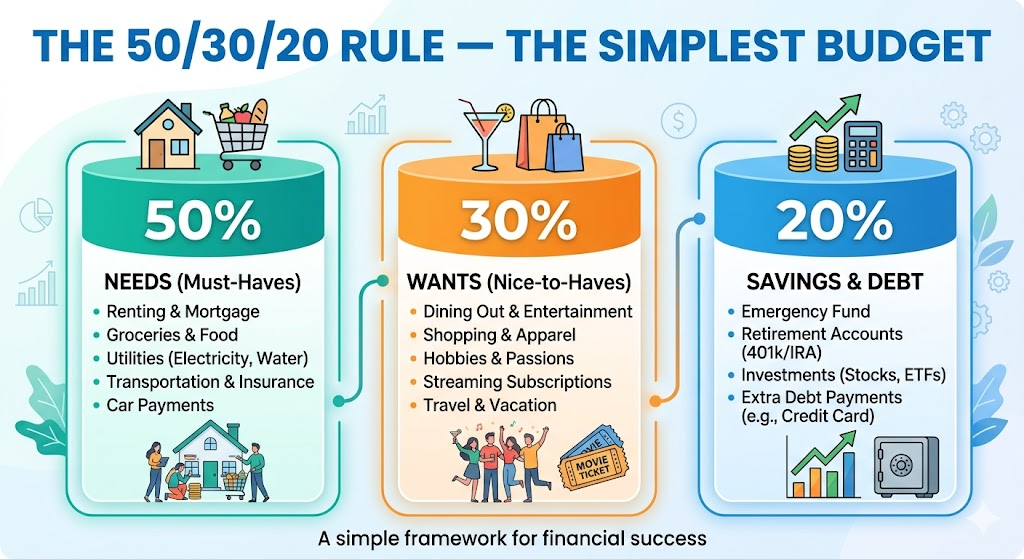
The 50/30/20 Adjustment
If you’re currently spending on a 50/30/20 split (needs/wants/savings), temporarily shift to 50/20/30 until your emergency fund is built. That extra 10% of take-home pay goes directly to your HYSA.
On a $5,500/month take-home salary, that’s $550/month—getting Sarah to her goal in about 43 months. Not fast enough? Keep reading.
Automate With “Invisible” Transfers
Set up an automatic transfer the day after every payday. If you never see it in your checking account, you won’t miss it. Start with whatever you can—$100, $200, $500. Increase it by $25 every month.
Stack These Accelerators:
- Tax refund allocation: The average 2025 tax refund was $3,167. Instead of blowing it, dump it straight into your emergency fund. That’s 13% of Sarah’s goal in one shot.
- Adjust your W-4: If you’re consistently getting large refunds, you’re giving the government an interest-free loan. Adjust your withholdings to put that cash in your pocket (and your HYSA) every paycheck instead.
- Cashback and rewards redemption: Route all credit card cashback to savings. Even $40–$80/month adds up to $500–$1,000/year.
- Side income sprints: Drive DoorDash, freelance, sell stuff on Facebook Marketplace. You don’t need a permanent side hustle—just a 3–6 month sprint dedicated to this one goal.
- Annual raise capture: Got a 3.5% raise? Send 100% of the increase to your emergency fund before your lifestyle adjusts.
Step 4: Build the Habit With Milestones
A $24,000 goal can feel overwhelming. Break it down:
- Milestone 1: $1,000 (your “mini emergency fund”—stops the credit card spiral)
- Milestone 2: 1 month of expenses
- Milestone 3: 3 months of expenses
- Milestone 4: Full 6 months
Celebrate each milestone. Not with a $500 shopping spree, but with something meaningful—a nice dinner out, a day off, the psychological satisfaction of knowing you’re now more financially secure than 60% of Americans.
Step 5: Protect It (Rules for Withdrawal)
An emergency fund only works if you define “emergency” clearly. Here’s the framework I give my clients:
✅ Legitimate Emergencies:
- Job loss or significant income reduction
- Medical emergency or unexpected health expense
- Critical home repair (burst pipe, furnace failure in winter)
- Emergency car repair needed for work commute
- Family emergency requiring travel
❌ NOT Emergencies:
- Holiday gifts
- A vacation deal that’s “too good to pass up”
- A new phone because yours is two years old
- Concert tickets
- “I forgot to budget for my insurance premium”
Rule of thumb: If you can plan for it, it’s not an emergency—it belongs in a separate sinking fund.
Common Mistakes That Derail Your Emergency Fund
After 15 years of advising clients, I see the same errors on repeat:
1. Trying to Invest AND Build an Emergency Fund Simultaneously
I’m a huge advocate for investing. But if you’re splitting $500/month between your emergency fund and a brokerage account, you’ll take twice as long to build financial security—and you might panic-sell investments during an actual emergency. Fund the emergency account first (or at least to 3 months), then resume investing.
The exception: always contribute enough to your 401(k) to get the full employer match. That’s free money with an immediate 50–100% return. Don’t leave it on the table.
2. Keeping It in a Checking Account
It’ll get spent. Period. Separate accounts with separate purposes is behavioral finance 101.
3. Setting a Vague Goal
“I want to save more” doesn’t work. “$23,790 by December 2027” works.
4. Raiding It for Non-Emergencies
Every time you dip in for something that isn’t a true emergency, you reset the psychological clock and erode trust in yourself.
5. Stopping Contributions After Reaching the Goal
Inflation erodes your fund’s purchasing power. Once you hit your target, contribute enough to offset inflation (roughly 3% annually). On a $24,000 fund, that’s about $720/year or $60/month.
6. Ignoring Tax Implications
Good news: interest earned in a savings account is taxable, but at your ordinary income rate—and we’re talking about relatively small amounts. On $24,000 at 4.5%, you’ll earn about $1,080 in interest. At a 22% marginal tax rate, that’s roughly $238 in additional federal tax. Worth it. Factor it in, but don’t let it stop you.
Should You Use an HSA, I Bonds, or Treasury Bills Instead?
Let me address some “optimization” strategies I see floating around personal finance social media:
Health Savings Account (HSA)
If you have a high-deductible health plan (HDHP), your HSA is an incredible wealth-building tool—but it’s not ideal as your primary emergency fund. Here’s why: withdrawal for non-medical expenses before age 65 incurs a 20% penalty plus income tax. Keep your HSA for long-term medical expenses and retirement. It’s the only triple-tax-advantaged account in the US tax code.
I Bonds
Series I Savings Bonds are currently paying around 3.1% (as of the May 2025 rate reset). They’re solid, but you can’t redeem them for the first 12 months, and you lose 3 months of interest if you redeem before 5 years. They’re great as a supplement to your emergency fund, not a replacement.
Treasury Bills (T-Bills)
With 3-month T-Bills yielding around 4.1% in early 2026, they’re competitive with HYSAs and state-tax-exempt. A T-Bill ladder can work for the portion of your emergency fund you’re less likely to need immediately (months 4–6). But months 1–3 should be instantly liquid in a HYSA.
The Emotional Payoff (Why This Changes Everything)
Let me tell you what happens when you have a fully-funded emergency fund:
- You sleep better. That low-grade financial anxiety fades.
- You make better career decisions. You can leave a toxic job without panic.
- You negotiate from strength. Knowing you have 6 months of runway gives you leverage.
- You stop accumulating bad debt. No more $3,000 credit card charges for car repairs at 24.99% APR.
- You start investing with confidence. Because you know your next dollar invested can truly stay invested for the long term.
I’ve seen clients transform their entire financial trajectory not because they earned more money, but because they built this one foundational buffer.
Your 30-Day Action Plan
Here’s what to do right now:
- Today: Calculate your monthly essential expenses and multiply by 6.
- This week: Open a high-yield savings account at an online bank offering 4.25%+ APY.
- This week: Set up an automatic transfer of at least $200 per payday.
- This month: Find one accelerator (tax refund, selling unused items, adjusting W-4, or starting a temporary side gig).
- This month: Tell one person your goal. Accountability works.
You don’t need to be perfect. You need to start.
Frequently Asked Questions
How much should I have in my emergency fund in 2026?
Most financial planners recommend 3–6 months of essential living expenses. For single-income households, self-employed individuals, or people in volatile industries, aim for 6 months minimum. In 2026, with elevated living costs and an evolving job market, 6 months provides the most security.
Where should I keep my emergency fund?
A high-yield savings account (HYSA) at an FDIC-insured online bank is the best option for most Americans. In 2026, top HYSAs are offering 4.25–4.75% APY, which beats inflation while keeping your money fully liquid and safe.
Should I build an emergency fund or pay off debt first?
Start with a $1,000 mini emergency fund to prevent new debt from unexpected expenses. Then aggressively pay off high-interest debt (credit cards at 20%+). Once high-interest debt is gone, build your full 6-month emergency fund before focusing on lower-interest debt like student loans or mortgages.
Is $1,000 enough for an emergency fund?
In 2026, $1,000 is a critical starting point—but it’s not enough. A single ER visit, car repair, or missed paycheck can easily exceed $1,000. Think of it as Phase 1 on your way to the full 6-month goal.
Should I invest my emergency fund in the stock market?
No. The stock market can drop 20–30% in a short period—which is often exactly when you’d need your emergency fund (job loss during a recession, for example). Your emergency fund’s job isn’t to grow wealth; it’s to be there when you need it, guaranteed.
Final Thought
Building a 6-month emergency fund isn’t glamorous. Nobody posts their HYSA balance on Instagram. There’s no viral TikTok strategy that makes it exciting.
But I promise you this: it is the single most impactful financial move you can make in 2026. It’s the foundation everything else—investing, homeownership, retirement planning, financial freedom—is built upon.
Start today. Not tomorrow. Not Monday. Not “when things settle down.” Today.
Your future self will thank you.
Have questions about building your emergency fund or want help creating a personalized savings plan? Drop a comment below or subscribe to the newsletter for weekly money strategies that actually work for everyday Americans.









Leave a Reply