


The Small Decisions That Determine Your Financial Destiny
Personal finance books, podcasts, and social media are filled with dramatic financial transformations — the person who paid off $80,000 in debt in 18 months, the couple who retired at 37, the 25-year-old with a $500,000 investment portfolio. These stories inspire, but they also intimidate. They make financial success look like the result of radical, exceptional action.
The reality is quieter and more accessible. Genuine, lasting wealth — for the vast majority of people — is not built through a single transformative decision. It is built through hundreds of small, consistent choices made correctly over years and decades. The $12 lunch you chose to pack instead of buying. The subscription you cancelled because you barely used it. The raise you invested instead of spent on a lifestyle upgrade. The night you cooked at home instead of ordering delivery.
These decisions seem trivial. Individually, they are. Compounded over 10–20 years — with the exponential engine of compound investment returns amplifying every dollar saved and invested — they become the architecture of financial security and freedom.
In this blog, we explore the psychological and mathematical foundation of daily financial habits — starting with the famous “Latte Factor” concept — and give you 7 concrete, actionable habits that, practiced consistently, will build substantial wealth over the next decade.
The Latte Factor: A Concept That Divided Personal Finance (And Why Both Sides Miss the Point)
The “Latte Factor” was introduced by financial author and advisor David Bach in his bestselling book “The Automatic Millionaire” (2004). The concept is straightforward: small, daily habitual expenditures — Bach’s original example was a $5 daily latte — quietly drain enormous amounts of money from your life over time. If that money were invested instead, the wealth accumulation would be substantial.
The Latte Factor Math in 2025 Dollars
Daily $7 coffee shop visit (a realistic 2025 price):
- Monthly cost: $210
- Annual cost: $2,520
- Invested at 10% average annual return for 30 years: $466,000
Weekly meal delivery for one person ($45 average, 3x per week, vs. cooking):
- Extra monthly cost vs. cooking: $390
- Annual extra cost: $4,680
- Invested at 10% for 20 years: $299,000
3 unused or barely-used subscriptions ($55/month combined):
- Annual cost: $660
- Invested at 10% for 25 years: $72,000
The total, invested over 20–30 years: $837,000 from three common spending habits.
Why Critics Have a Point — and Why They Still Miss the Bigger Picture
The Latte Factor has been criticized — often correctly — for implying that young people’s financial struggles are primarily caused by discretionary spending rather than stagnant wages, student debt burdens, housing unaffordability, and systemic economic factors. This critique is valid. A $7 latte is not why someone cannot afford a house in San Francisco or pay off $120,000 in student loans.
But the critics miss the larger point Bach was making: it is not specifically about coffee. It is about developing financial consciousness — the habit of recognizing that every spending decision has a future cost or opportunity, and making those decisions deliberately rather than habitually. The Latte Factor is a frame for thinking about money across your whole life, not a prescription for miserly deprivation.
The goal is not to eliminate joy. It is to distinguish between spending that genuinely adds to your life quality and spending that you do habitually, without thought, and would not miss if it were gone.
7 Daily Money Habits That Build Real Wealth
Habit 1: Track Every Dollar You Spend for 30 Consecutive Days
Financial awareness is the foundation of all financial change — and most people have no idea where their money actually goes. They have a rough sense of their major expenses, but the dozens of small transactions between paychecks are largely invisible.
For exactly 30 days, record every single expense without judgment or behavior change. Use any method: your banking app’s transaction history, a budgeting app (Mint, YNAB, Copilot, Monarch Money), a simple Google Sheet, even a notebook. The medium does not matter — the discipline does.
At the end of 30 days, categorize your spending and look at the total in each category. What you discover will likely surprise you. Most people find 3–5 areas of significant unintentional spending they had completely rationalized or forgotten: the food delivery habit they thought cost $80/month that actually costs $280. The Amazon “small purchases” that add up to $340. The three streaming services they collectively watch for under 4 hours per week.
This habit — practiced once thoroughly and reviewed monthly — consistently frees up $200–$800/month for people who previously insisted they could not save more.
Action: Open your last 60 days of bank and credit card statements right now. Add up your food delivery total. Add up your subscriptions total. Add up your shopping total. The number will likely be higher than you expect.
Habit 2: Implement the 48-Hour Rule for Non-Essential Purchases
The modern retail ecosystem is an extraordinarily sophisticated machine engineered to trigger impulse purchases. Flash sales create artificial urgency. “Limited stock” messaging creates manufactured scarcity. App notification badges create compulsion. One-click purchasing removes friction. AI-powered recommendation engines surface items calibrated specifically to your past desires. Every UX decision in e-commerce is designed to bypass your rational deliberation and move you from “I’m browsing” to “order confirmed” as quickly as possible.
The 48-hour rule is your defense: for any non-essential purchase above $50, close the browser or app, and wait 48 hours before returning to make the decision. Do not save the item for later. Do not add it to your cart. Walk away completely.
After 48 hours, a significant percentage of the purchase desire will have naturally evaporated. The psychological research on impulse purchasing shows that the emotional intensity driving a purchase decision diminishes dramatically within 24–48 hours of the initial trigger. You were not buying the product — you were buying relief from the emotional state the marketing created.
Studies in consumer behavior consistently find that 60–80% of impulse purchase intentions fade within 48 hours. For those that remain after 48 hours of rational deliberation, the purchase is genuinely desired rather than impulsively triggered.
Estimated monthly savings for the average young adult who shops frequently: $100–$400/month.
Habit 3: Cook at Home at Least Five Days a Week
Food is consistently among the largest variable expense categories for young adults in developed countries. The gap between home cooking costs and dining-out or delivery costs is staggering — and it widens every year as restaurant and delivery app prices increase with inflation and labor costs.
The average American spends approximately $3,639/year dining out (BLS Consumer Expenditure Survey). The equivalent food spend at home for the same nutritional value runs $1,200–$1,800/year — a difference of $1,800–$2,400 annually. For someone living in a major metro area using delivery apps regularly (where service fees, delivery fees, and tips can add 30–40% on top of menu prices), this gap is easily $400–$600/month.
This is not a suggestion to eliminate dining out as a social and pleasurable activity. It is a suggestion to make it intentional rather than habitual — dining out because you genuinely want that experience, not because you have not planned your week’s meals and there is nothing in the refrigerator.
The practical system: On Sunday, spend 20 minutes planning five weekday meals. Write a grocery list. Shop once. Batch-cook two things that store well in the refrigerator (a grain, a protein). Reserve dining out for genuine social occasions or deliberate treats.
Estimated savings at modest implementation: $150–$400/month. Invested at 10% for 20 years: $114,000–$304,000 in additional wealth.
Habit 4: Conduct a Subscription Audit Every Quarter
We live in the peak of subscription culture. The average American household now pays for 4–6 streaming services, 2–4 software subscriptions, 2–3 app subscriptions, and various other recurring services — many of which were acquired enthusiastically and are now barely used.
The insidious design of subscription services: they are built to be easy to start and psychologically difficult to cancel. The cancellation process is often deliberately buried in settings menus. Services auto-renew silently. Some offer discounts when you try to cancel — training you to feel like you are “losing a deal” by leaving.
Set a recurring calendar reminder for the first Sunday of every third month: Subscription Audit. Open your bank statements and credit card statements. Filter for recurring charges. Make a list. For each: When did I last use this? Would I notice if it were gone? Is it genuinely worth the cost?
Cancel everything that does not pass a clear “yes” on all three questions. This takes 20–30 minutes and commonly saves $50–$150/month for young adults — $600–$1,800/year — money that can be immediately redirected to investments.
Global note: This habit applies identically across all developed markets. UK residents, Australians, Canadians — the subscription economy is global. The audit habit is universally applicable.
Habit 5: Invest Every Salary Increase Before You Spend It
This habit is the most impactful on this list — and the one requiring the most conscious resistance to powerful psychological forces.
When your income increases — through a raise, a promotion, a new job, a side income stream — your lifestyle spending will naturally try to expand to meet it. This phenomenon, known as lifestyle inflation (or lifestyle creep), is one of the most powerful and predictable patterns in consumer psychology. It is not weakness or greed — it is a deeply human tendency to normalize our circumstances and then desire more.
The problem: lifestyle inflation is the primary reason that so many people who earn significantly more at 35 than at 25 do not have significantly more wealth. Their spending has expanded in lockstep with their income, leaving the same percentage (or less) available for saving and investing.
The Pre-Commitment Strategy: When you learn about an income increase, immediately and automatically increase your savings rate before the new income enters your regular checking account. This is the power of pre-commitment — making the correct decision before the money arrives and the spending temptation activates.
Practical implementation:
- Salary increases: the day you start earning more, increase your 401(k) contribution percentage or your automatic investment transfer. Aim to capture at least 50% of the increase.
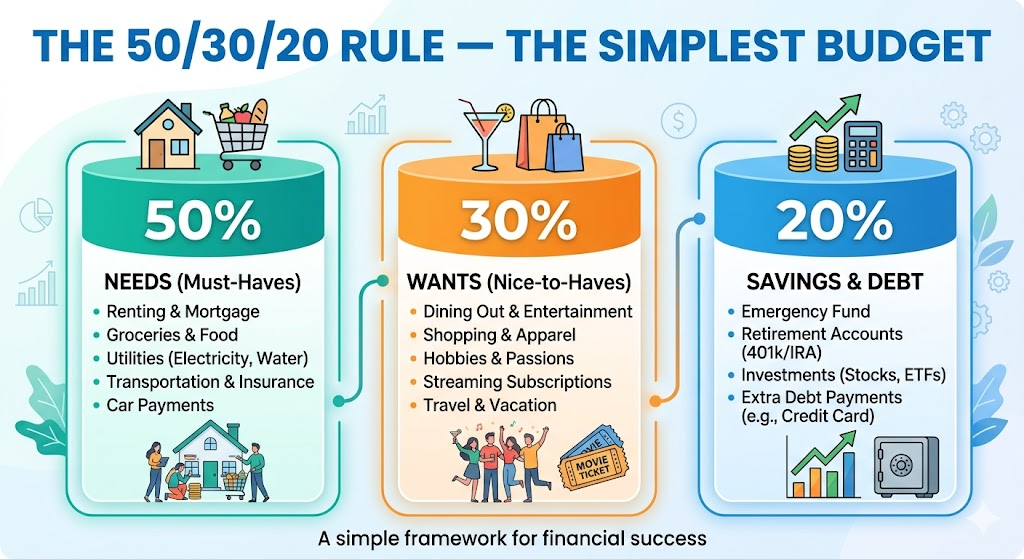
- Annual bonuses: before depositing, decide the allocation. A common framework: 50% to investments/savings, 30% to debt payoff, 20% for lifestyle (a deliberate treat for earning the bonus).
- Side income: treat 100% of side income as investment capital until your retirement accounts are maxed. You have already established your lifestyle on your primary income.
The long-term impact: Someone who invests 50% of every raise from age 25 to 45 will retire with two to three times the wealth of an equally-paid peer who invests only their base savings rate — even if the peer earns more on average.
Habit 6: Automate Everything — Remove Willpower From the Equation
The most reliable financial plans do not depend on daily willpower and decision-making. They depend on systems that work automatically, regardless of how tired, busy, stressed, or distracted you are on any given day.
Research in behavioral economics — from Nobel laureate Richard Thaler’s work on “nudge” theory to decades of retirement savings studies — consistently shows that automatic enrollment and automatic escalation dramatically increase savings rates compared to requiring active, conscious decisions each period.
What to automate: Your 401(k) contribution is already automated through payroll. Set it and let it run.
Open a Roth IRA and set up a recurring monthly transfer on your paycheck deposit date. Choose the amount. Confirm it once. Then do not think about it again until you receive the annual statement showing your growing balance.
Set up automatic investment in your brokerage account for any amount above your emergency fund threshold in your HYSA. Many platforms allow automatic monthly purchases of your chosen index fund.
Automate your bill payments to avoid late fees — a small but meaningful source of waste for people in their 20s.
The goal is to make financial progress the path of least resistance. When the correct actions happen automatically, the daily financial decisions that remain — what to buy for lunch, whether to go out tonight — become lower stakes because the important financial decisions have already been made on your behalf by your past self.
Habit 7: Review Your Net Worth Monthly — Not Just Your Bank Balance
Your bank balance is a single data point with very limited information. It tells you how much cash you currently have — but nothing about whether you are building or destroying wealth.
Your net worth is the complete financial picture: total assets minus total liabilities.
Assets: checking and savings balances, investment portfolio value (401k, Roth IRA, brokerage, HSA), the current market value of owned property, vehicle value, business equity.
Liabilities: student loan balance outstanding, car loan balance, mortgage balance, credit card debt, personal loan balance, any money owed.
Net worth = Assets – Liabilities.
A person with $5,000 in the bank but $40,000 in credit card debt has a net worth of negative $35,000. A person with $2,000 in the bank but $120,000 in investment accounts and $60,000 in student loans has a net worth of positive $62,000. The bank balance alone tells you almost nothing meaningful.
The monthly net worth review habit: Once a month (many people do this on the 1st), spend 15 minutes updating a simple spreadsheet with all asset values and all outstanding debt balances. Calculate your net worth. Compare it to last month.
Is it growing? Good — maintain or accelerate. Is it flat or declining? Your spending is outpacing your wealth building — identify why and adjust.
Tracking net worth transforms wealth-building from an abstract aspiration into a concrete, measurable game with monthly feedback. The psychological power of watching your net worth grow month after month — especially once the compounding of investments accelerates in years 3–5 — is one of the most powerful motivators in personal finance.








Leave a Reply